
Artificial Intelligence (AI) is no longer a futuristic concept—it’s today’s reality. In 2026, AI technology is transforming nearly every aspect of our lives, from how we work and shop to how we drive and receive healthcare. This rapid evolution presents endless opportunities for innovation, growth, and problem-solving across industries.
What Is AI Technology?
AI technology refers to the development of computer systems capable of performing tasks that typically require human intelligence. These tasks include learning, reasoning, problem-solving, understanding language, and even perceiving the environment. Common subfields of AI include: AI Technology in 2026: Revolutionizing the Future of Business and Daily Life
Machine Learning (ML) – systems that learn from data without being explicitly programmed
Natural Language Processing (NLP) – enables machines to understand and respond to human language
Computer Vision – allows computers to interpret and analyze visual data
Robotics – integrates AI with physical machines to perform complex tasks
By combining large data sets with intelligent algorithms, AI systems can now perform real-time decision-making, self-correction, and predictive analytics.
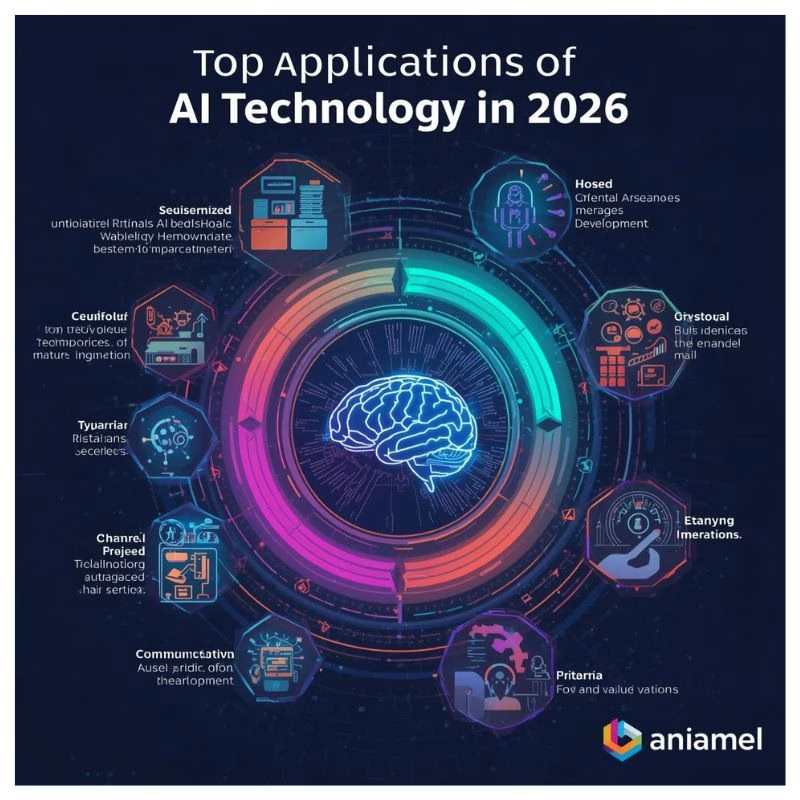
Top Applications of AI Technology in 2026
1. AI in Healthcare
In 2026, AI plays a critical role in diagnosing diseases, analyzing medical images, predicting patient risks, and even developing new drugs. Tools powered by AI can scan radiology images in seconds and detect early signs of illnesses like cancer more accurately than the human eye.
AI-powered chatbots and virtual health assistants also provide 24/7 patient support, easing the workload on healthcare professionals and improving accessibility.
2. AI in Finance
Banks and financial institutions rely on AI for fraud detection, algorithmic trading, and customer service. Real-time fraud alerts powered by AI help prevent unauthorized transactions, while robo-advisors assist individuals in managing investments based on real-time market data and personal risk profiles.
Machine learning models are also being used to assess creditworthiness, making lending more inclusive and data-driven.
3. AI in Transportation
Autonomous vehicles, powered by AI, are making roads safer and more efficient. Self-driving cars use AI to interpret sensor data, make navigation decisions, and avoid obstacles.
AI is also used in traffic management systems to reduce congestion and optimize public transportation routes.
4. AI in Retail and E-commerce
AI technology enhances customer experience by offering personalized product recommendations, managing inventory, and automating customer service with intelligent chatbots.
Retailers use AI to analyze consumer behavior and preferences, enabling highly targeted marketing campaigns and improved product placement.
5. AI in Education
In the education sector, AI tailors learning experiences based on individual student performance. Smart tutoring systems adapt lesson plans in real-time, providing instant feedback and helping students stay engaged.
AI also automates administrative tasks such as grading and attendance tracking, allowing teachers to focus more on instruction.
Benefits of AI Technology
Increased Efficiency: AI can automate repetitive tasks, reducing time and human error
Cost Savings: Businesses cut down on operational costs with intelligent automation
Data-Driven Decisions: AI analyzes large datasets to provide actionable insights
Personalization: AI enables customized user experiences, boosting engagement and satisfaction
Innovation: Companies are developing entirely new products and services through AI capabilities
Challenges of AI
Despite its benefits, AI technology raises ethical and technical challenges:
- Data Privacy: AI systems need access to vast amounts of personal data
- Job Displacement: Automation may replace certain human jobs
- Bias and Fairness: AI models can unintentionally reflect and amplify human biases
Organizations must address these concerns with strong regulations, ethical AI practices, and transparent development processes.
The Future of AI
AI is evolving fast, with advancements like Generative AI, Explainable AI, and AI-as-a-Service (AIaaS) gaining popularity. In the future, AI will become more accessible, interpretable, and integrated into our everyday tools.
By 2030, experts predict AI will contribute over $15 trillion to the global economy. Businesses that adopt AI early will gain a competitive edge, while those that don’t may struggle to survive in an increasingly digital world.